Sanshu Ju Kunisuke Katana
三州住國佐 刀
Item TK039
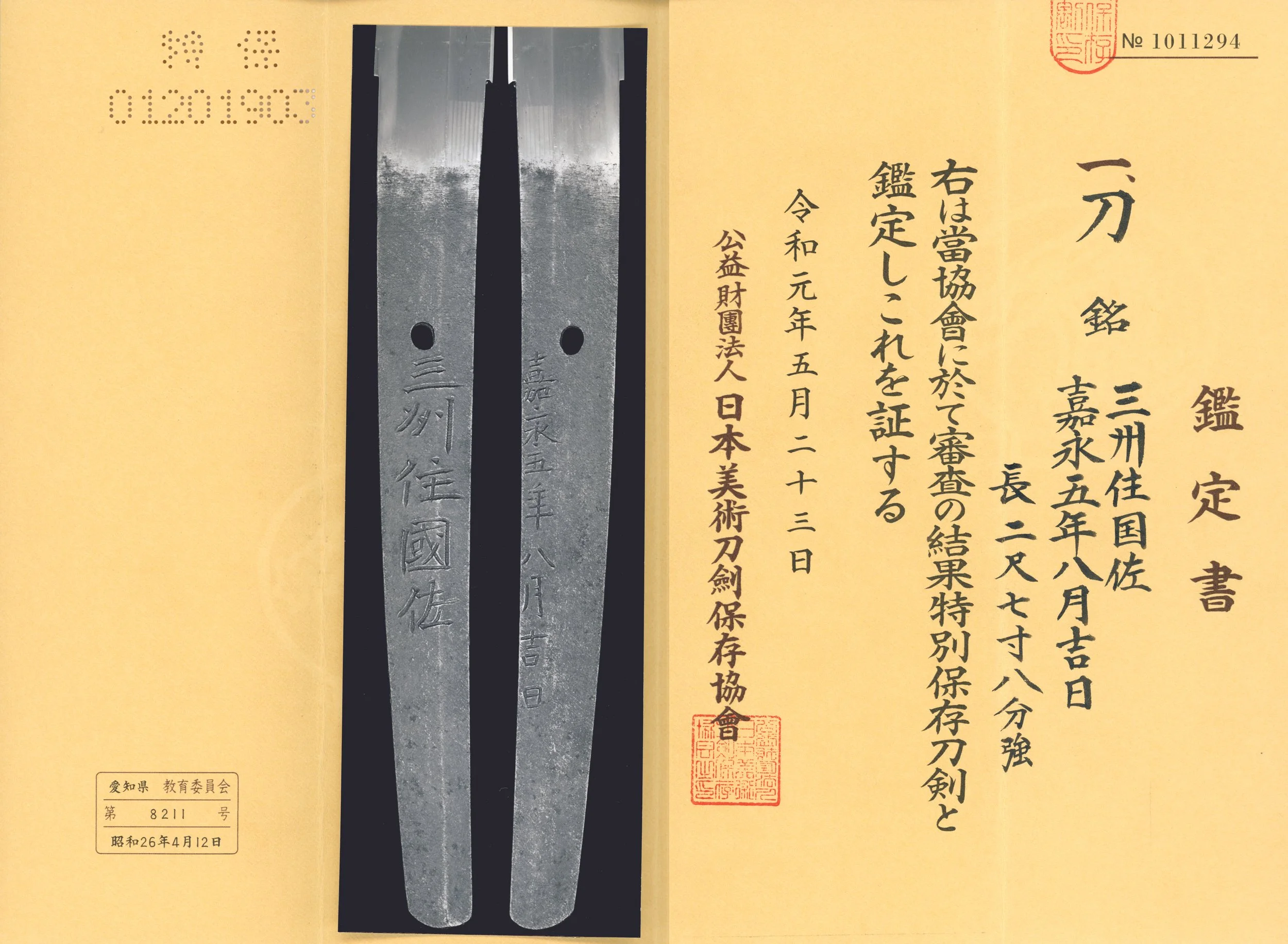
Period: Shinshinto — Late Edo Period (1852)
Mei (Signature): 三州住國佐 Sanshu Ju Kunisuke
嘉永五年八月吉日 An auspicious day in August, Kaei 5 (1852)Designation: Tokubetsu Hozon
Nakago - 23.6cm Ubu, 1 Mekugi-ana
Nagasa - 84.2cm
Sori: - 2cm
Motohaba - 3.2cm
Sakihaba - 2.2cm
Kissaki - 4.8cm
Motokasane - 0.81cm
Price: ¥ 1,500,000
Sanshū-jū Kunisuke (三州住国佐) - Direct Student of Koyama Munetsugu (固山宗次)
Sanshū-jū Kunisuke (三州住国佐) was a swordsmith active in Mikawa Province (present day eastern Aichi Prefecture) during the late Edo period. He is best understood as a direct student of the highly regarded Koyama Munetsugu, placing him within one of the most important Shinshintō lineages. Munetsugu, ranked jō jō saku, was a leading figure of the period, known for producing blades that balanced cutting performance with refined workmanship in the Bizen Tradition. Kunisuke’s work reflects this strong technical foundation and direct transmission of skill.
Like his master, Kunisuke worked in the Bizen tradition, producing blades with well forged ko itame jigane. His workmanship clearly reflects the influence of Munetsugu, both in technical execution and in adherence to classical ideals. This places him firmly within the broader Shinshintō movement, where smiths actively sought to revive the styles and spirit of the great Koto period masters. Rather than simple imitation, this revival represented a deliberate return to earlier forging methods, structures, and aesthetics, aiming to recapture the strength, activity, and refinement seen in Kamakura and Nanbokuchō works.
Kunisuke’s dated works are known from the Kaei through Bunkyū eras mid 19th century, a time of increasing political instability in Japan. During this period, demand grew for robust and functional blades.
Kunisuke stands among the notable Mikawa smiths of the period, alongside names such as Yoshitatsu and Hiroshige. His work embodies the late Edo revivalist spirit, technically controlled, rooted in classical Bizen forms, yet executed with the vitality and strength demanded of the time. Mikawa is the birthplace of Tokugawa Ieyasu.
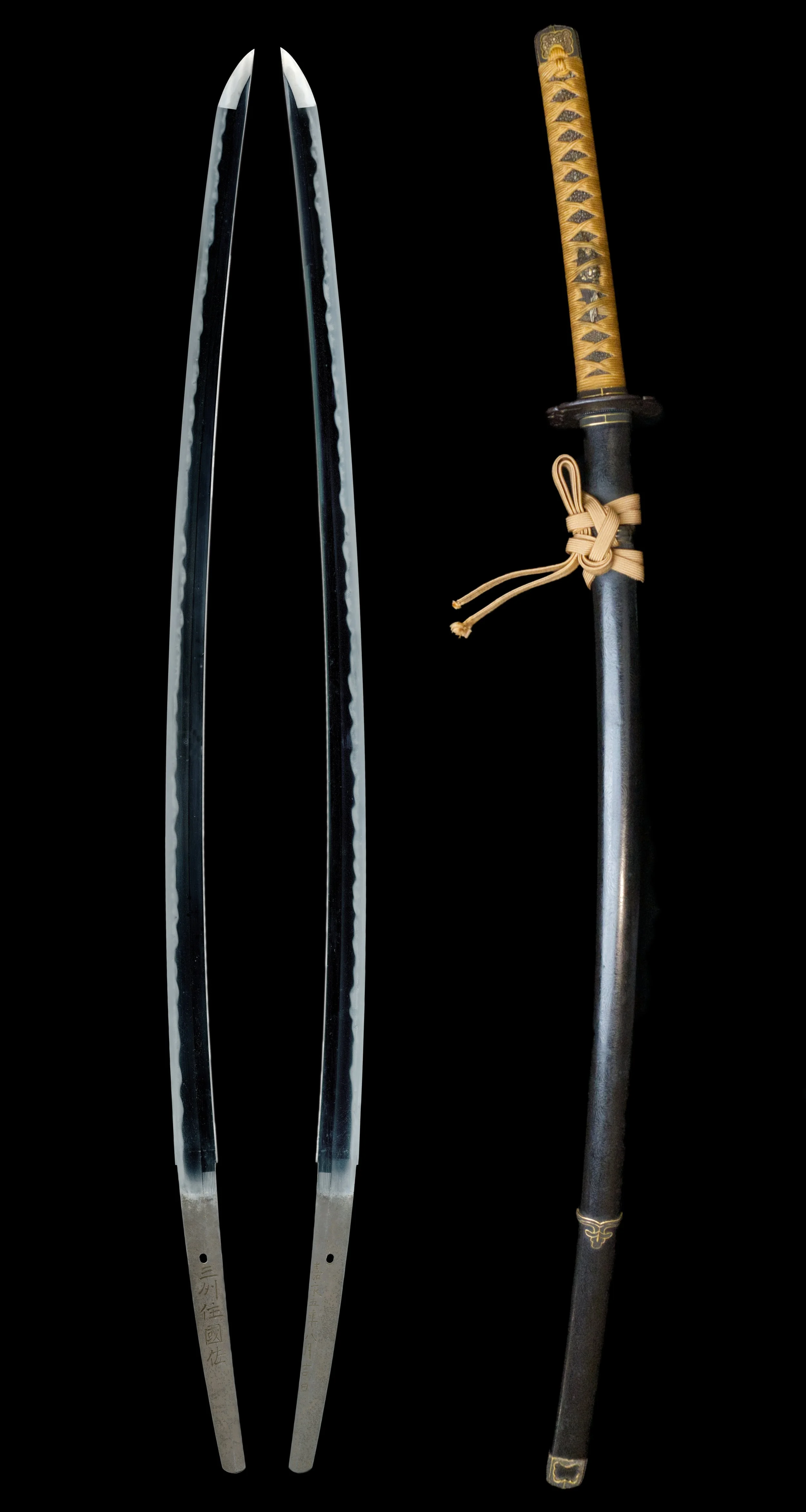
This blade is constructed in shinogi-zukuri with an iori-mune, presenting a powerful and well-balanced sugata. With a nagasa of 84.2 cm, it is exceptionally long, far exceeding the average for the period, and immediately commands attention. The proportions are particularly appealing, featuring a thick kasane and an extended chū-kissaki. The kissaki itself is especially sharp in appearance. Personally, I find the overall shape extremely attractive, with a strong yet elegant profile that reflects both function and intention. The jigane is forged in the Bizen tradition, closely reflecting the style of his master, Koyama Munetsugu. It displays a very tight and well-forged ko-itame hada, characteristic of Bizen workmanship, with a clean and controlled surface.
The hamon is a ko-gunome mixed with chōji-style pattern, consistent with Bizen influence. There are abundant ashi present throughout the hamon, running consistently along the cutting edge. Ashi are often understood to play a role in enhancing the structural integrity of the edge, helping to prevent large fractures and contributing to effective cutting performance. Overall, this is a very consistent and sharply executed piece of work from the Shinshinto Period. Amazing shape, excellently executed jigane and hamon. We highly reccomend this piece.
This blade comes with a Bakamatsu period koshirae, consistent with the late Edo aesthetic where practicality and restrained design were emphasized. The mounts reflect the functional style typical of the period, with a cohesive and understated appearance. The Tsuka is very long, matching the long nakago and nagasa of the blade. The saya is finished in a black kinma urushi style lacquer. This blade was made in 1852, one year before Mathew Perry arrived to Japan.