
Custom Koshirae Services at Touken Takarado
At Touken Takarado, we offer bespoke koshirae services for clients seeking authentic Japanese sword mountings made in Japan. In today’s environment, the creation of traditional cultural works such as koshirae is fundamentally relationship based. Access to skilled craftsmen, scheduling their work, and coordinating multiple specialists requires long standing trust and direct connections within the Japanese sword community.
Touken Takarado maintains active relationships with a wide network of craftsmen across Japan, ranging from highly skilled working artisans to Mukansa level masters. Whether you are seeking a straightforward, durable koshirae intended for martial arts use, or a fully realized museum grade koshirae, we are able to guide and manage your project from concept to completion.
Costs and Production Time
The cost and timeframe of a koshirae project vary significantly depending on several factors, including
• Whether the client supplies existing fittings or requests that we source fittings on their behalf
• The style of koshirae desired
• The type and complexity of lacquer work, which is often the largest factor affecting production time
• The specific craftsmen involved and their individual schedules
Due to the high demand for traditional craftsmen and the steadily decreasing number of artisans working in this field, Touken Takarado currently offers koshirae services exclusively to clients who have purchased blades from us. This allows us to maintain quality control, realistic timelines, and responsible use of our relationships.
In addition, clients who purchase a blade from us that is currently mounted in shirasaya may also request the arrangement of a suitable koshirae. In such cases, Touken Takarado can assist in coordinating the design, sourcing fittings if required, and overseeing the production process in Japan.
As a general guideline, the production of a custom koshirae typically requires six months to two years, depending on the style chosen and the availability of the craftsmen involved. We place emphasis on proper workmanship over speed, ensuring that each koshirae is made in keeping with traditional standards and historical integrity.
Custom Koshirae for a Juyō Wakizashi by Sukenao
Commissioned by President of Touken Takarado
The above Koshirae obtained an Effort Award in the 2024 Contemporary Swords and Artworks Competition
Koshirae are far more than protective mountings for a Japanese sword. They represent the final and most personal stage in a blade’s life, where function, aesthetics, and the owner’s philosophy converge. Through choices of form, materials, and workmanship, a koshirae gives context to the blade it houses, whether emphasizing dignity and restraint, battlefield practicality, or refined luxury.
The koshirae shown above was custom commissioned by the President of Touken Takarado specifically for his Juyō wakizashi by Sukenao. The intention was not simply to create an ornate mounting, but to produce a koshirae that harmonized with both the character of the blade and his own personal aesthetic. Mr Uchihara was directly involved in every stage of the process, personally sourcing and selecting each component of the fittings. The koshirae features solid gold menuki, along with a tsuba and fuchi kashira chosen to complement the blade’s dignity and presence. Particular care was taken to ensure thematic consistency, with the menuki and fuchi kashira sharing a unified design language. The result is a koshirae enhances the overall appreciation of the blade, demonstrating how thoughtful commissioning can elevate a sword into a complete and cohesive work.
Today, many Japanese swords are appreciated in shirasaya, allowing the blade itself to be studied in its purest and most honest form. This is a appropriate way to preserve and evaluate a sword, particularly from an academic or connoisseur’s perspective. However, for collectors who wish to explore another dimension of appreciation, commissioning koshirae offers a deeply rewarding path. Creating mounts that complement a blade’s character, period, or intended spirit can be an enjoyable and highly personal experience. For those who choose this journey, Touken Takarado is pleased to offer guidance and support throughout the koshirae commissioning process, working closely with trusted craftsmen to help transform a blade into a fully realized sword that reflects both tradition and the owner’s individual taste.
Different Styles of Koshirae
There are many different styles of koshirae, each reflecting varying approaches to form, decoration, and purpose. Some emphasize elegance and visual richness through the use of precious materials and intricate metalwork, while others prioritize simplicity, durability, and practicality. Preferences often differ from collector to collector, with some drawn to refined and luxurious mountings, and others favoring understated or rugged designs. The styles introduced below represent only a small selection of the many approaches to koshirae, offered as examples to illustrate the diversity and depth found within traditional Japanese sword mountings.
Daisho Koshirae
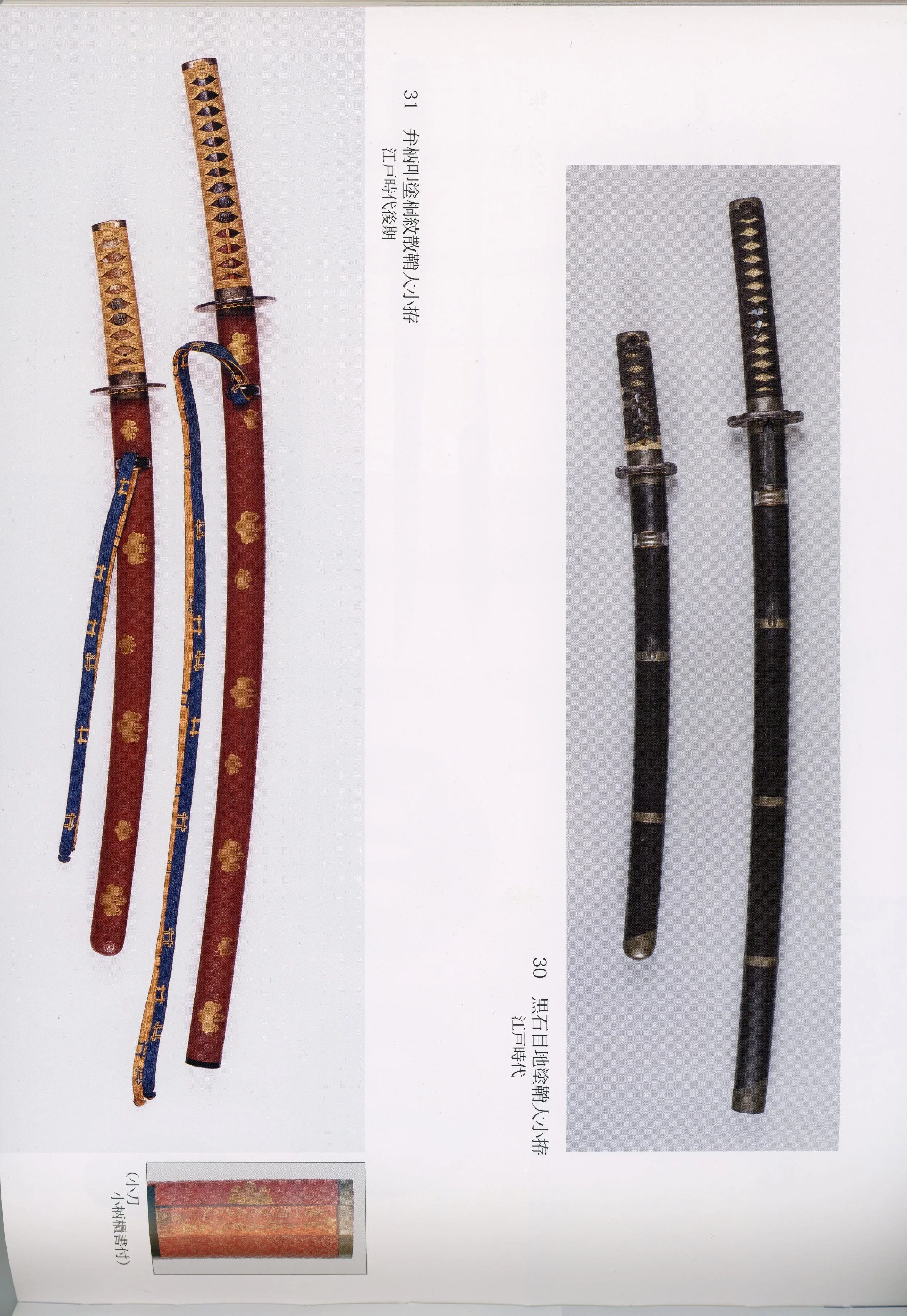
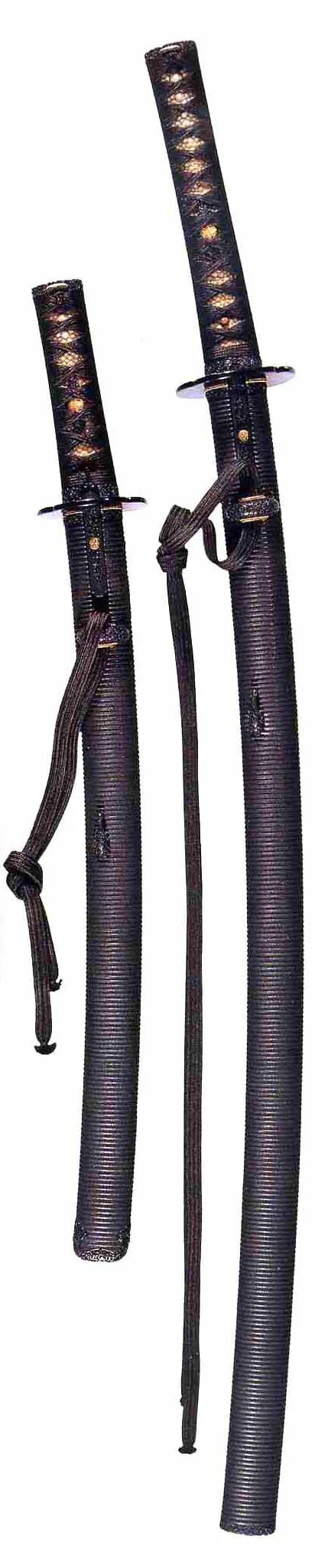
A daishō refers to the wearing of a long sword and a short sword together. Daishō koshirae describe the mountings made for these two swords when worn in this manner. While it is often assumed that daishō always featured fully matching koshirae, this was not universally the case, as the level of coordination often reflected the status and wealth of the samurai who commissioned them. That said, from a modern collector’s perspective, a thoughtfully matched daishō koshirae can be especially appealing, creating a strong sense of balance and visual harmony between the two swords.
Banzashi Koshirae
Bazashi koshirae 番指大小 developed during the Edo period as a formal style of mounting required when samurai attended Edo Castle or appeared before the shōgun under the sankin kōtai system. These koshirae were defined by strict conventions, including black lacquered scabbards, hilts covered in white samegawa, and carefully regulated fittings. The fuchi kashira and menuki were typically adorned with the samurai’s family crest, reinforcing both identity and rank. Designed to be dignified and restrained, bazashi koshirae reflected the formality of court service and were also used for swords presented as official gifts, making them an important expression of status and protocol in Edo period Japan.
Handachi Koshirae
Handachi koshirae are a style of mounting that combines elements of tachi fittings with katana koshirae. The term "handachi" means "half-tachi". Typical features include the use of tachi style metal fittings on the scabbard, such as ashi and semegane, while the sword is worn edge up in the manner of a katana. This hybrid form brings together the dignified appearance of tachi mounts with the practicality of katana wear, making handachi koshirae a distinctive and well regarded style among collectors.
Tensho Koshirae
The style takes its name from the Tenshō era and reflects the demands of a time when functionality was a priority. As the uchigatana became more commonly worn by samurai during this period, Tenshō koshirae evolved to support this new manner of sword carry.
A defining characteristic of Tenshō koshirae is the distinctive shape of the hilt, which features a gentle narrowing at its center, known as ryūgo gata. This form creates a sense of balance between the hilt and scabbard while contributing to a clean and purposeful overall appearance. The tsuka is typically constructed with samegawa as its foundation to improve grip and durability, often finished with a leather wrapping. Scabbards are usually finished in subdued black or brown lacquer, and the tsuba are most commonly forged from iron or yamagane with minimal ornamentation, reinforcing the understated and functional nature of this style.
Many koshirae styles are closely tied to specific regions of Japan, with each developing its own aesthetic preferences, materials, and approach to sword mounting. These regional traditions were shaped by local schools, domain culture, and the values of the warriors who commissioned them, resulting in distinct differences in appearance and character. Some styles favor quiet restraint and refined simplicity, while others embrace bold ornamentation or rugged practicality. Today, collectors are able to commission koshirae in styles that resonate with their own tastes, whether inspired by historical regional traditions or adapted to suit a more personal vision. Understanding these regional influences allows collectors to better appreciate how a koshirae can reflect not only the blade it houses, but also the individual character of its owner.
Regional Styles of Koshirae
Higo Koshirae
Higo Koshirae refers to a regional style of Japanese sword mounting originating in Higo Province (modern-day Kumamoto Prefecture) during the Edo period. Closely associated with the warrior culture of the Hosokawa clan, it embodies an austere aesthetic that values restraint, practicality, and refined taste over overt decoration.
The style was profoundly influenced by Hosokawa Tadaoki, a daimyo and renowned tea practitioner whose sensibilities shaped Higo craftsmanship through principles drawn from wabi-cha. As a result, Higo Koshirae favors subdued finishes and functional elegance rather than flamboyance.
Typical features include thick, plain iron tsuba produced by schools such as Hirata and Hayashi, simple iron or shakudō fuchi-kashira, leather tsukamaki for durability, and saya finished in understated black or brown lacquer. The tsuka is often slightly shorter and gently tapered, reflecting a practical approach suited to agile sword handling.
Satsuma Koshirae

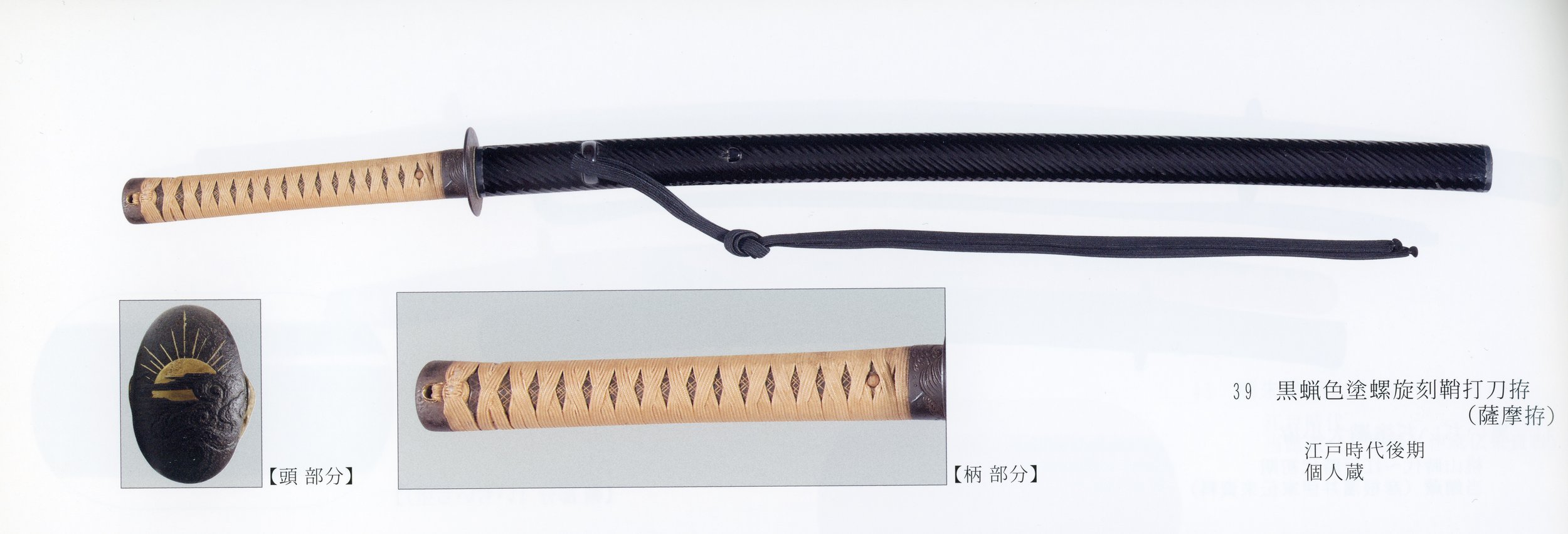
Satsuma Koshirae is a regional style of Japanese sword mounting that developed in the Satsuma domain under an exceptionally martial culture, shaped in particular by the sword traditions of Jigen ryu and Yakumaru Jiken ryu. In contrast to more decorative Edo period mountings, Satsuma koshirae is typically robust, large in proportion, and austere, with a clear emphasis on battlefield practicality. The tsuka is often long and purposefully shaped, sometimes with an inward curvature or in a tachitsuzumi gata drum form, and the base covering is frequently not traditional samegawa, but instead lacquered leather or a copper plate foundation, with menuki often omitted. Scabbards are commonly finished in vermilion, though black and other distinctive lacquer treatments are also encountered, paired with notably rugged fittings and an enlarged kurikata. The most defining feature of Satsuma Koshirae is the kaeri zuno, a prominent protrusion at the mouth of the scabbard, designed so that when the sword is drawn together with the saya it does not catch on the obi, an important consideration in the forceful and direct drawing methods characteristic of Satsuma swordsmanship.