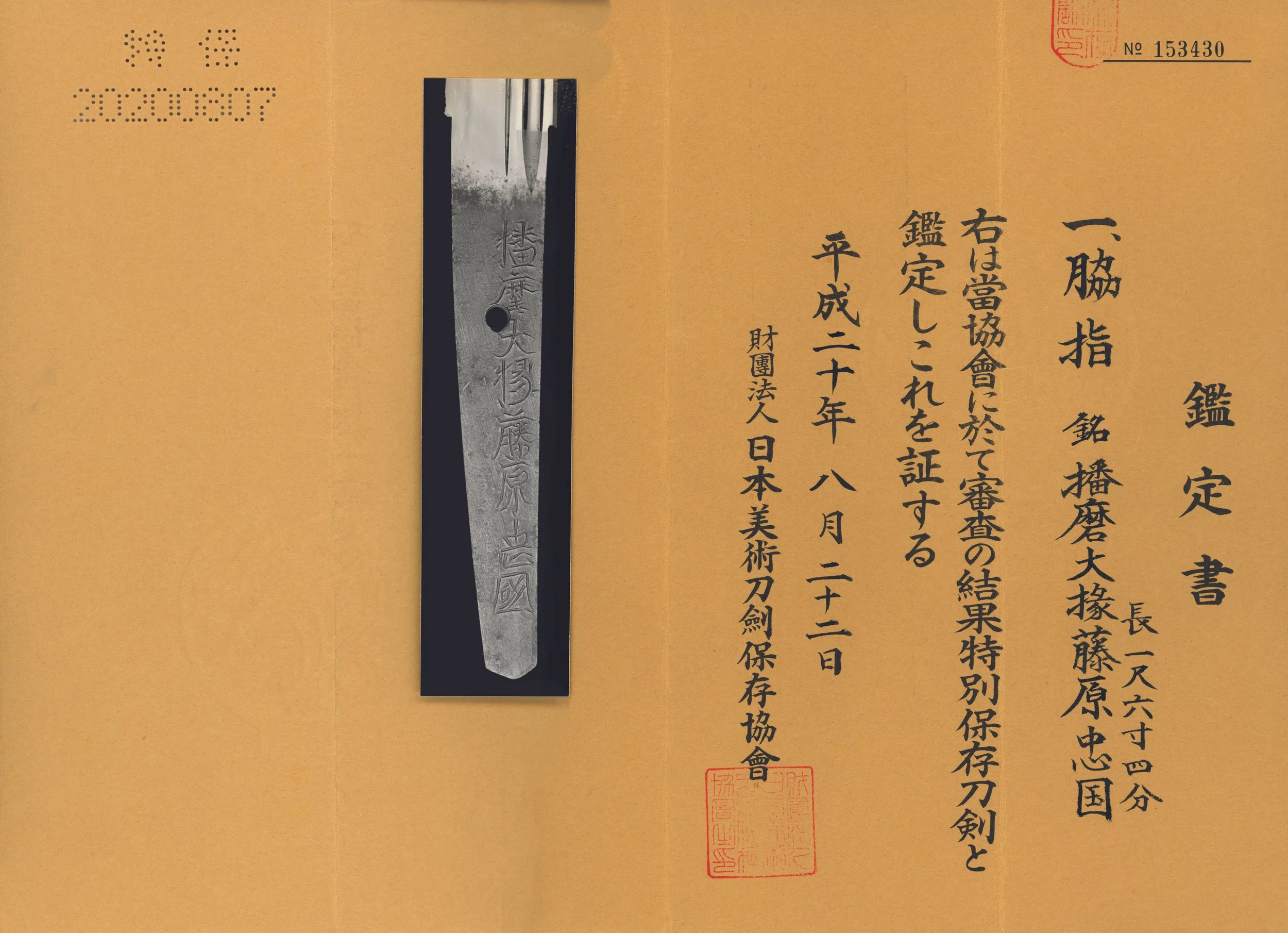
Harima Daijo Fujiwara Tadakuni Wakizashi
播摩大掾藤原忠国 脇差
Item TK041
Period: Shinto (1600s)
Mei (Signature): 播摩大掾藤原忠国Harima Daijo Fujiwara Tadakuni
Designation: Tokubetsu Hozon
Nakago - 14.9cm - Ubu - One Mekugi-ana
Nagasa - 49.6cm
Sori: - 1.7cm
Motohaba - 3cm
Sakihaba - 2.7cm
Kissaki - 10cm
Motokasane - 0.7cm
SOLD
Harima Daijō Fujiwara Tadakuni (播磨大掾藤原忠国)
Harima Daijō Fujiwara Tadakuni was a leading swordsmith of the early Edo period and an important figure within the Hizen tradition. Born in Keichō 9 (1604) as Hashimoto Rokurōzaemon, he was the son of Hashimoto Hirosada. Hirosada was the younger half-brother (by a different mother) of the first generation Hizen no Kuni Tadayoshi I, placing Tadakuni in direct blood relation to the founder of the Hizen Tadayoshi school.
Tadakuni originally signed Hironori (広則) when he started his career. Then, he changed it to Tadakuni when he received an official Harima Daijyo (播磨大掾) rank in the 11th year of the Kanei era (1634) when he was 31 years old. This marked his formal recognition as an accomplished smith within the Nabeshima domain.
During the Shoho era (1644 to 1648), Tadakuni entered service under the Ogi branch of the Nabeshima clan in Saga. Under Nabeshima Motoshige, son of the Saga daimyo Nabeshima Katsushige, the domain fostered a strong martial tradition. Motoshige himself was reputed to be highly skilled in various martial disciplines, including swordsmanship, and this environment likely supported consistent demand for high quality blades produced by Tadakuni.
As a smith of the Hizen tradition, Tadakuni’s work reflects the school’s hallmark refinement, particularly in the forging of a tight and well-forged jigane, often associated with the use of high-quality imported steel. His blades are well regarded for their consistency, elegance, and strong connection to the foundational workmanship of the Hizen Tadayoshi lineage.
Tadakuni enjoyed a long career, eventually passing on his school to the next generation in his later years. He died in Genroku 4 (1691) at the age of 88.
This wakizashi is made in the naginata naoshi style (ubu), exhibiting a powerful and commanding presence. Constructed in iori-mune, the blade maintains an impressive width from the motohaba through to the sakihaba, culminating in a massive ō-kissaki measuring approximately 10 cm. The sugata is both bold and elegant. A well-carved naginata-hi runs along the blade, accompanied by a soe-bi
The jigane displays the hallmark konuka-hada of the Hizen tradition. This fine, tightly forged grain is exceptionally consistent throughout the blade, with no visible weak areas in the ji. The steel surface is clean, dense, and uniform, reflecting the quality expected of Hizen workmanship.
The hamon is a notare pattern in nie-deki, executed with great precision. The nie is particularly fine and bright along the entire length of the hamon, giving the blade a vivid and refined appearance under light. It concludes in a beautifully formed and exceptionally well-defined sansaku-maru boshi.
This wakizashi is accompanied by an aikuchi wakizashi koshirae, unified throughout by a consistent dragon motif. The fittings are coordinated, with the menuki, kozuka, and kogai all depicting dragons, a motif traditionally associated with power, wisdom, and protection in Japanese iconography.
The saya is finished in aogai mijin nuri (青貝微塵塗), a finely sprinkled mother of pearl lacquer technique. Minute particles are evenly dispersed across the surface, producing a subtle shimmering effect under light. Depending on the angle, soft tones of blue, green, gold, and violet can be observed, giving the surface a layered and dynamic appearance.
The aikuchi form is clean and understated, allowing the lacquer work and fittings to stand out without excess. The contrast between the dark lacquer ground and the iridescent aogai finish creates a balanced and refined overall impression.
Altogether, this koshirae is a well executed mounting that combines cohesive fittings with carefully applied lacquer work, complementing the blade.
Shodai Tadakuni Close up Video