Mumei Attributed to Taima Wakizashi
無名 当麻 脇差
Item TK042
Period:Koto - Late Kamakura period (13th century) to the early Nanbokucho period (14th century).
Designation: Tokubetsu Hozon
Mei (Signature): Mumei
Nakago - cm - O-Suriage Mumei - 2 Mekugi Ana
Nagasa - 45.7cm
Sori - 0.15cm
Motohaba - 2.7cm
Motokasane - 0.5
SOLD
Koto Period Naginata Naoshi Wakizashi attributed to Taima School (Yamato-den)
This blade is attributed to the Taima school (当麻), one of the five Yamato traditions active from the late Kamakura to early Nanbokuchō period (late 13th to early 14th century) in Yamato Province. The Taima group is closely associated with Taima-dera in present-day Nara, a historically significant location that served as an important hub in ancient Japan. The school is understood to have developed within the sphere of Kōfuku-ji Temple and was supported by its religious and political influence.
The founder of the school is traditionally identified as Kuniyuki (国行), who was active around the Shōō era (1288–1293). The Taima lineage continued to flourish into the Nanbokuchō period. Like other Yamato schools, Taima smiths produced blades primarily for powerful temple complexes and warrior monks, who required dependable weapons during a time of frequent conflict between rival religious institutions. Their work was also supplied to the samurai class during this period.
This blade is an excellent example of a naginata-naoshi (薙刀直し), a form converted from a naginata. Originally mounted as a polearm, the naginata featured a long shaft with a curved blade at the tip and had been in use since at least the Heian period. As battlefield needs evolved, many naginata were shortened and reshaped into katana or wakizashi, better suited for later styles of combat.
Characteristic features of naginata-naoshi are clearly present here. The curvature is concentrated toward the tip, creating a continuous flowing sori from the hamachi to the kissaki. While the blade retains a defined shinogi, it does not exhibit a yokote, reflecting its origin as a polearm rather than a purpose-forged sword. The shape is extremely sharp looking.
The jigane is finely forged, displaying a exceptionally tight itame-hada with areas of flowing itame-nagare visible across the ji. The steel has the characteristic dark appearance associated with koto-period workmanship, yet remains well refined and consistent throughout. Notably, toward the kissaki, the hada transitions into a masame-like structure towards the munesaki side of the tip, a well-recognized trait of the Taima school often referred to as “Taima-hada.” This feature is a strong kantei point and adds to the blade’s overall character.
The hamon is a chū-suguha in nie-deki, executed in a controlled and consistent manner. Within the hardened edge, fine activities such as kinsuji and inazuma are present, lending subtle movement and vitality to an otherwise restrained temper line.
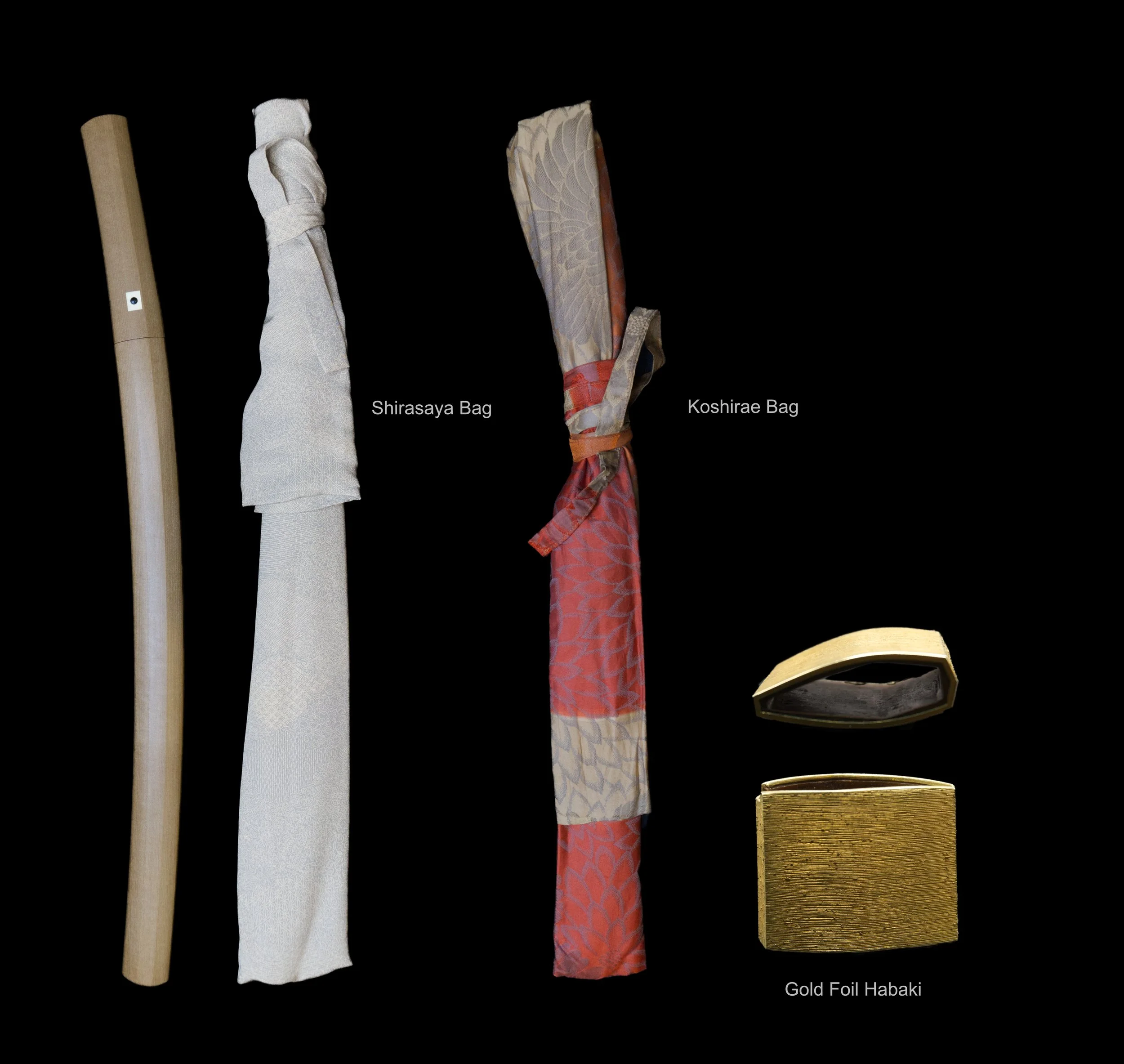
Accompanied by an aikuchi wakizashi koshirae. The menuki depict peony (botan) motifs in dark metal with gold-accented leaves, symbolizing prosperity and strength. The kozuka features a warabi (bracken fern) design, representing resilience and growth.
The saya is finished in vermillion urushi using the mushi-kuinuri technique, a specialized lacquer method that creates a textured, irregular surface resembling natural insect wear. This effect is intentionally produced through layered lacquer and controlled finishing, resulting in a subtle, organic pattern that enhances depth and visual character.
“Taima Hada”
Mumei Taima Wakizashi Close up Video