
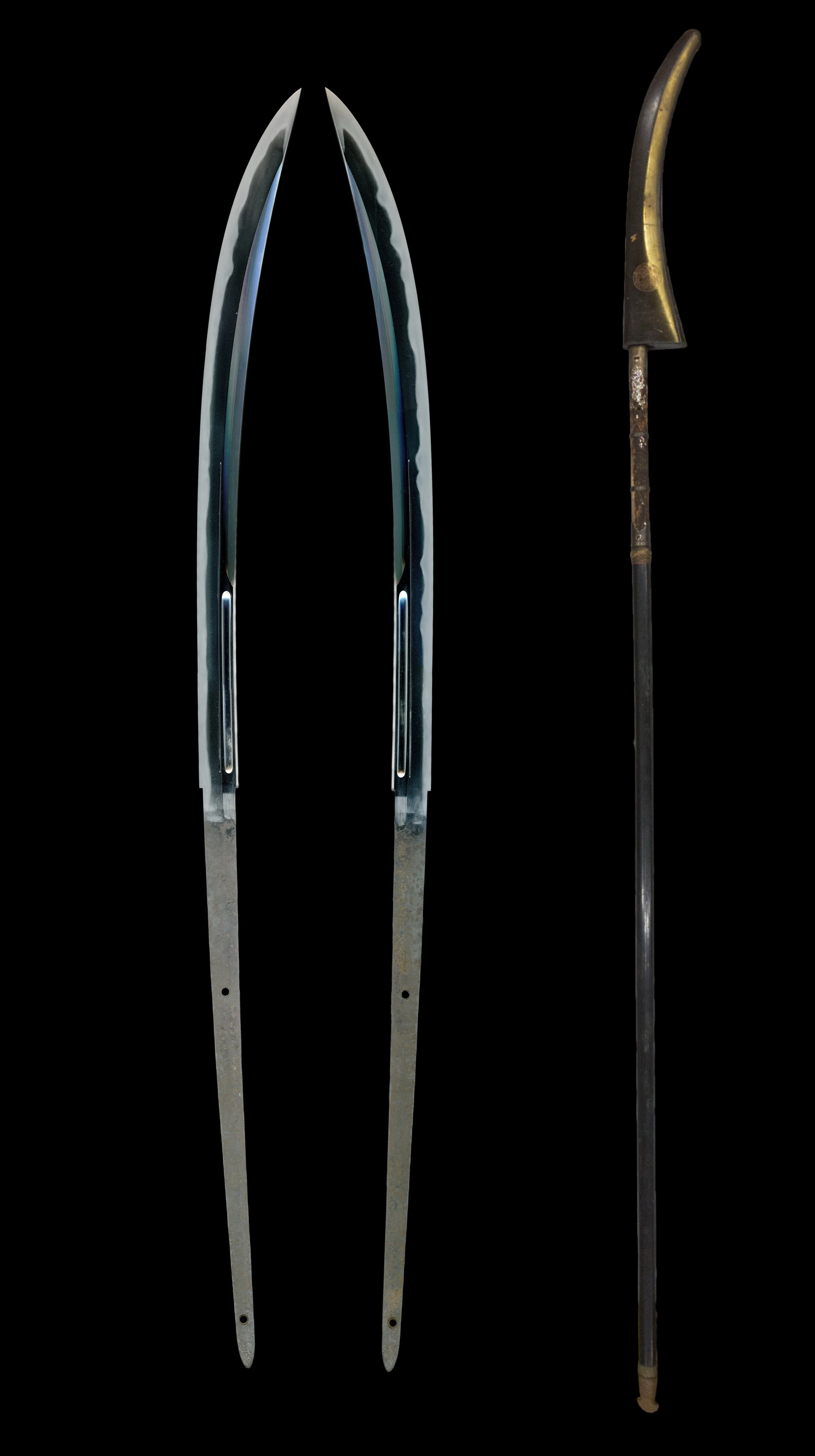
Harima no Kami Fujiwara Teruhiro Naginata
播磨守藤原輝広 薙刀
Item TK056
Period: Shinto — Early Edo Period
Mei (Signature): Harima no Kami Fujiwara Teruhiro
播磨守藤原輝広Designation: Tokubetsu Hozon
Nakago - Ubu, 2 Mekugi-ana
Nagasa - 50cm
Sori: - 2.2cm
Motohaba - 2.85cm
Motokasane - 0.85cm
Nakago Length - 41cm
Price: ¥ 850,000
Harima no Kami Fujiwara Teruhiro — Early Shintō Naginata of the Geishū Tradition
Harima no Kami Fujiwara Teruhiro (播磨守藤原輝広) was a distinguished early Edo-period swordsmith of the Geishū tradition, working in Aki Province, present-day Hiroshima Prefecture. The Teruhiro lineage had its origins in Mino and became closely associated with Hiroshima after entering the service of the powerful daimyō Fukushima Masanori around the beginning of the seventeenth century. Following the establishment of the Asano family in Hiroshima, the school continued to prosper as an important lineage of domain smiths.
Harima no Kami Teruhiro was closely connected with Higo no Kami Teruhiro, under whom he studied before becoming his son-in-law and successor. The Teruhiro school also demonstrates a significant connection to the celebrated Kyoto master Umetada Myōju, whose influence can be recognized in the refined workmanship of their blades. Harima no Kami Teruhiro received the honorary title Harima no Kami (播磨守) during the Keichō era, and dated works from his productive period survive into the Kan'ei era.
His workmanship is characteristic of the sophisticated early Shintō tradition. The jigane is generally well-forged itame and ko-itame, while the hamon frequently displays notare and gunome-based compositions enriched with nie, sunagashi, kinsuji, and other fine hataraki. At its best, Teruhiro's work is noted for its clear and refined jiba, dense nioiguchi, and vigorous nie activity. The quality and similarities between the work of Harima no Kami Teruhiro and Higo no Kami Teruhiro are such that distinguishing the two can present a considerable challenge even in traditional kantei.
This naginata presents a magnificent and commanding sugata, at once powerful and remarkably elegant. A deeply carved naginata-hi accompanied by soe-bi follows the curvature of the blade and further accentuates its dynamic form, while the substantial mitsu-mune and exceptionally thick kasane give the blade an imposing sense of strength and volume. Despite these robust proportions, the overall shape remains beautifully balanced and graceful.
The jigane is a tightly and finely forged ko-itame, representative of Teruhiro's accomplished workmanship, displaying a remarkably clear, well-knit and refined surface with an excellent degree of uniformity. The hamon is based in notare mixed with gunome, with elements of chōji appearing throughout and lending further variation to the temper. Within the ha are abundant fine activities, with sunagashi and kinsuji running vigorously throughout, producing a lively and highly detailed yakiba. The combination of refined jigane and rich hataraki gives the blade considerable visual depth and character, rewarding close examination across its entire length.
Overall, this naginata survives in exceptional, near-pristine condition for a work dating from the Shintō period. The naginata is accompanied by a period naginata koshirae, adding to the completeness of the piece. Of particular interest is a faded family crest (kamon) visible on the saya, a subtle remnant of its former ownership and long history