Hizen Kuni jū Ōmi Daijō Fujiwara Tadayoshi (4th Generation)
肥前国住近江大掾藤原忠吉
Item TK061
Period: Shinto Period - 1700 onwards
Mei (Signature): 肥前国住近江大掾藤原忠吉
Designation: Tokubetsu Hozon
Nakago - Ubu - 1 Mekugi-Ana
Nagasa - 71.8cm
Sori: - 2cm
Motohaba - 3.1cm
Sakihaba - 2.1cm
Kissaki - 3.2cm
Motokasane - 0.72cm
Nakago length - 21.4cm
¥ 2,000,000
Hizen Kuni jū Ōmi Daijō Fujiwara Tadayoshi (4th Gen)
This katana is the work of the fourth generation Tadayoshi of the renowned Hizen sword making tradition, who signed his blades Hizen Koku Ju Omi Daijo Fujiwara Tadayoshi. He was born in 1667 as Hashimoto Gensuke, the son of the third generation Tadayoshi, Mutsu no Kami, and the grandson of the celebrated second generation Tadahiro.
He received extensive training under his grandfather, Tadahiro, and is known to have produced numerous swords on his behalf as daisaku. Being entrusted with such work demonstrates both his ability as a swordsmith and the confidence placed in him within the Hashimoto family workshop.
In 1700, during the Genroku era, he received the prestigious court title Omi Daijo (近江大掾), after which he used the signature seen on this katana. Like many works of the Hizen tradition, his swords were commonly signed in tachi mei, while dates were often omitted from the nakago.
This katana has a particularly attractive and commanding shape, constructed in shinogi zukuri with an iori mune. The curvature is more pronounced than is commonly encountered in Hizen works, giving the blade a bold and dynamic profile. This is likely due to the sword being made in a Keichō Shintō style shape. The blade feels substantial in hand, while the overall balance of its width, thickness, curvature and point gives it an especially pleasing and dignified form.
The jigane is an exceptionally fine and beautifully controlled konuka hada, one of the defining characteristics of the Hizen tradition. The grain is extremely tight and refined, displaying the characteristic fine, almost rice bran like texture for which the finest Hizen blades are admired. More importantly, this quality is maintained with remarkable consistency throughout the entire length of the blade.
This consistency is particularly noteworthy. Among Hizen swords, one of the qualities that can distinguish an excellent blade from a more ordinary example is not simply the presence of konuka hada, but the degree to which the smith was able to maintain its refinement and uniformity throughout the jigane. On lesser examples, there are usually weakspots. On this blade, however, the hada remains extraordinarily fine and controlled from beginning to end, giving the steel a remarkably clean and harmonious appearance. It is an excellent demonstration of the highly disciplined forging for which the mainline Hizen Tadayoshi school became renowned.
The hamon is chū suguha, executed with the restraint and precision characteristic of the Hizen tradition. The temperline is composed of extremely fine, bright nie, producing a clear and elegant boundary against the beautifully refined jigane. Rather than relying upon an overly flamboyant temper pattern, the workmanship derives its appeal from precision, clarity and consistency, the quiet sophistication that is so characteristic of high quality Hizen work.
The condition of the blade is equally exceptional. It is in sublime condition. Perfect, I’d say, with an exceptionally clean surface that allows the quality of both the jigane and hamon to be appreciated without distraction. Its preservation gives the impression of a blade that has been carefully protected throughout its long history.
The nakago remains ubu, preserving the sword in its original form with a single mekugi ana. Combined with its excellent state of preservation, substantial shape, beautifully uniform konuka hada, and finely executed chū suguha, the blade presents the workmanship of the fourth generation Tadayoshi with exceptional clarity.
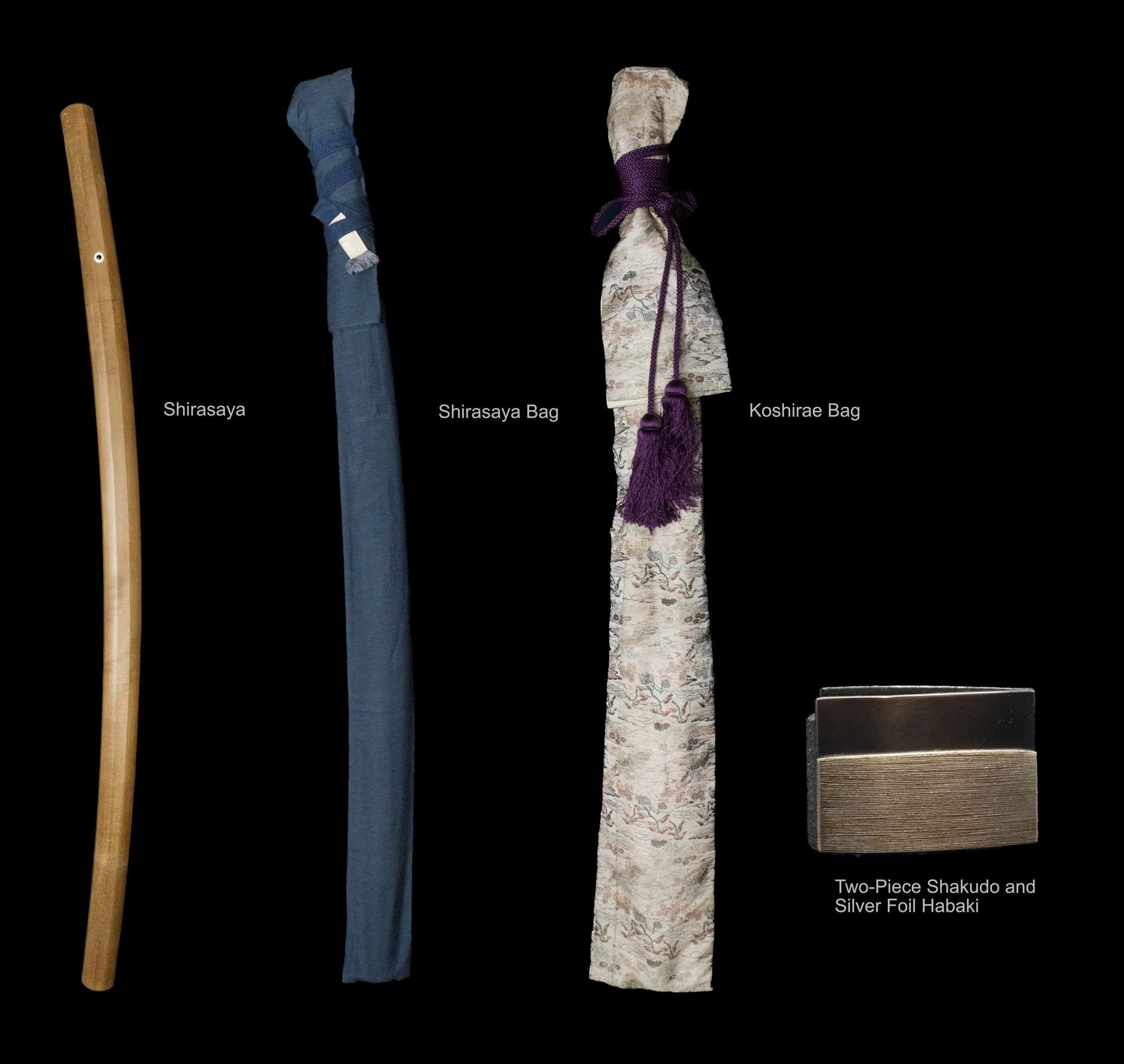
The blade is accompanied by a very nice Edo period koshirae, complete with a full suite of matching fittings executed in a unified dragon theme. The theme is carried throughout the mounting, even extending to the kurigata, which itself features a dragon motif. The saya is finished in elegant black lacquer, with a distinctive section of kizami on the upper portion of the saya, adding texture and character while complementing the overall aesthetic of the koshirae.
This is a particularly desirable full package, combining an impeccable condition, high quality katana with a very nice and complete Edo period koshirae.
Fine and bright Nie