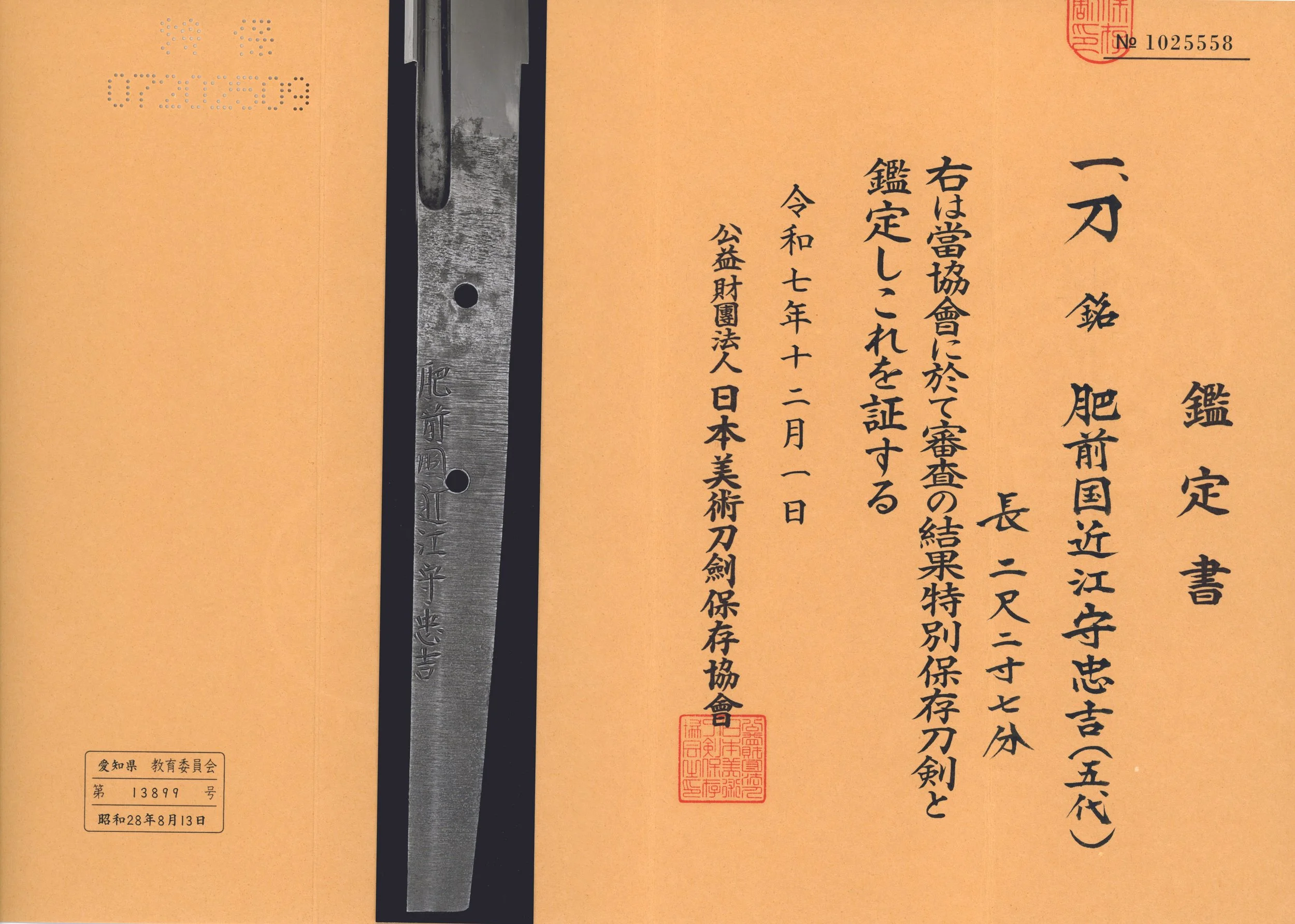
Hizen no Kuni Omi no Kami Tadayoshi (5th Gen) Katana
肥前国近江守忠吉(五代) 刀
Item TK062
Period: Shinto Period
Mei (Signature): Hizen no Kuni Omi no Kami Tadayoshi 肥前国近守忠吉
Designation: Tokubetsu Hozon
Nakago - Two Mekugi-Ana
Nagasa - 68.7cm
Sori: - 1.2cm
Motohaba - 3.1cm
Sakihaba - 2.2cm
Kissaki - 4.3cm
Motokasane - 0.8cm
Nakago length - 22.3cm
¥ 950,000
Hizen no Kuni Omi no Kami Tadayoshi (5th Gen)
The 5th Generation Tadayoshi (五代忠吉), also known as Omi no Kami Tadayoshi (近江守忠吉), was born in 1696 as the eldest son of the 4th generation Omi Daijo Tadayoshi (近江大掾忠吉). He began his career around 1716, initially signing “Hizen Kuni Tadahiro” (肥前国忠廣) while his father was still active, and is known to have also signed dai-mei on his father’s behalf in later years.
Following the death of his father in 1747, he changed his signature to “Hizen Kuni Tadayoshi” (肥前国忠吉). In 1750, he received the honorary title “Omi no Kami” (近江守), after which he began signing “Hizen Kuni Omi no Kami Tadayoshi” (肥前国近江守忠吉) — the exact mei found on this blade. He continued working until his passing in 1775, at the age of 80.
The 5th generation marks the end of the Shinto-era Tadayoshi lineage, before the school transitioned into the Shinshinto period with the 6th generation.
The blade is iori-mune with relatively shallow sori and a broad, substantial sugata, retaining good width from the motohaba through to the sakihaba. It is notably thick, with a substantial kasane of approximately 0.8 cm. Despite these robust proportions, the large bō-hi reduces the weight considerably, giving the sword a surprisingly light and well-balanced feel in hand.
The jigane displays the characteristic Hizen konuka-hada, finely and tightly forged. The hamon is an elegant chū-suguha, gradually widening as it approaches the kissaki. Overall, the blade is a very clean and attractive example of Hizen-tō, combining the refined workmanship of the Tadayoshi school with an unusually broad and substantial construction.
The blade is accompanied by a handsome koshirae, with well-matched fittings that complement the sword nicely. Tasteful and traditional in appearance, the mounting presents the blade as a complete and attractive ensemble.