
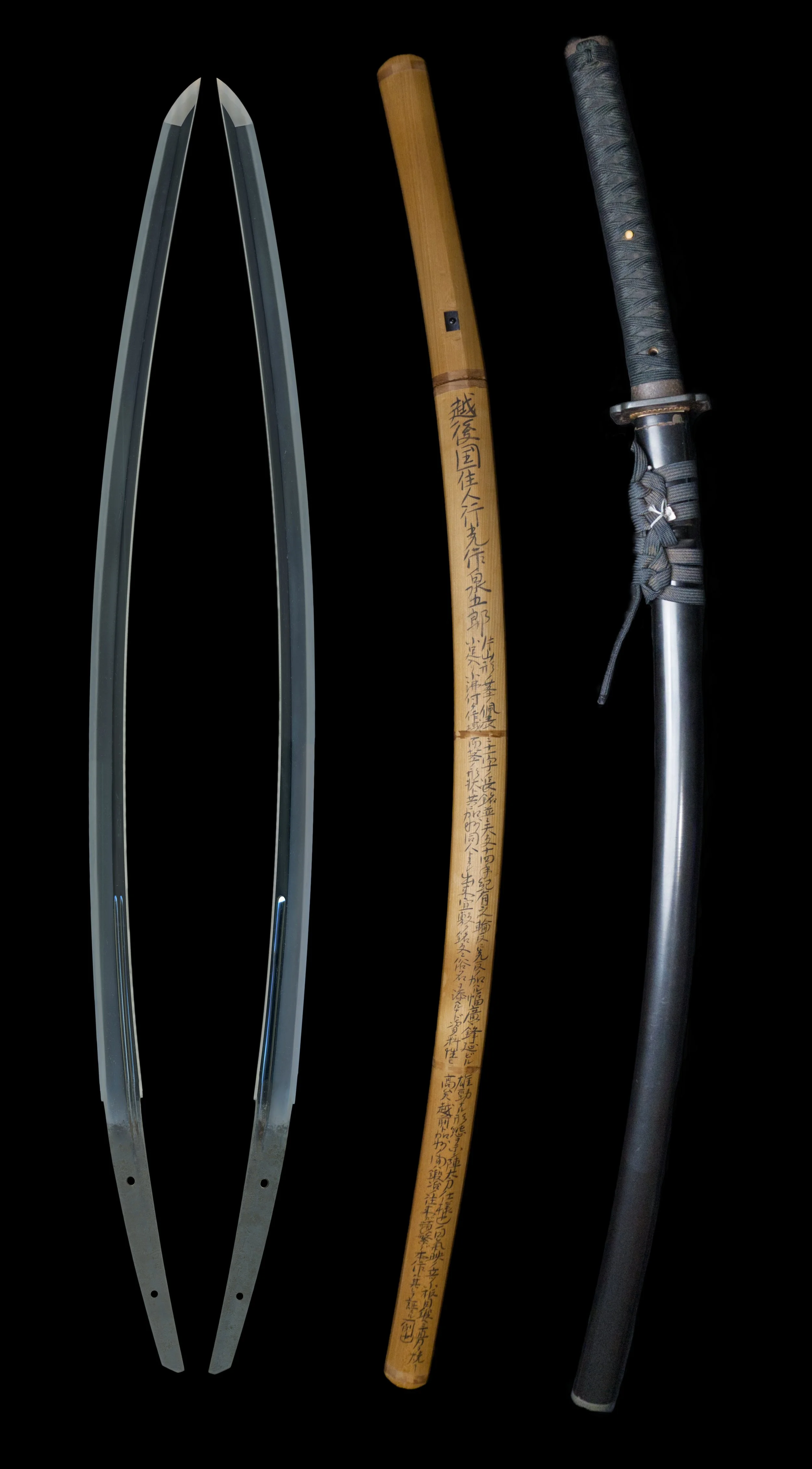
Echigo no Kuni Jūnin Yukimitsu Saku Sengorō Tachi
越後国住人行光作泉五郎 太刀
Item TK070
Period: Koto - Late Muromachi - Tenbun 12 (1543)
Mei (Signature): Echigo no Kuni Jūnin Yukimitsu Saku Sengorō
Inscribed: “Made by Yukimitsu, resident of Echigo Province, Sengorō.” 越後国住人行光作泉五郎
“A lucky day in the eighth month of Tenbun 12 (1543).” 天文拾二年八月吉日 Designation: Tokubetsu Hozon
Nakago - Ubu - 2 Mekugi-Ana
Nagasa - 76.1cm
Sori: - 3.3cm
Motohaba - 3.15cm
Sakihaba - 2.1cm
Kissaki - 4cm
Motokasane - 0.8cm
Nakago length - 20.6cm
¥ 2,300,000
A Grand Tachi Exhibiting Utsuri by Echigo no Kuni Jūnin Yukimitsu Sengorō – Dated Tenbun 12 (1543)
Yukimitsu, commonly known as Izumigorō (泉五郎), was a Japanese swordsmith active during the late Muromachi period, particularly throughout the Kyōroku and Tenbun eras (1528–1555), in the midst of Japan's turbulent Sengoku period.
He is traditionally identified as the fourth generation of the Yukimitsu lineage belonging to the Fujishima school of Kaga Province (present-day Ishikawa Prefecture). The lineage traces its origins to the Nanbokuchō period, beginning with the first-generation Yukimitsu, who worked during the Eiwa era (1375–1379) and was traditionally regarded as the second son of the first-generation Fujishima Tomoshige. The name continued through successive generations, with the second generation active during the Ōei era (1394–1428) and the third during the Kōshō era (1455–1457).
Originally associated with Kaga Province, the fourth-generation Yukimitsu is said to have relocated to Kashiwazaki in neighbouring Echigo Province (present-day Niigata Prefecture), where he continued his swordmaking activities under the name Izumigorō. His surviving works bear inscriptions identifying him as a resident of Echigo, including Echigo no Kuni Jūnin Yukimitsu Saku Izumigorō (越後国住人行光作 泉五郎).
His period of activity coincided with the rise of the powerful Uesugi clan in Echigo, particularly the early life of Uesugi Kenshin (1530–1578), who would later become one of the most celebrated military commanders of the Sengoku period.
Among the notable works attributed to this Echigo-based Yukimitsu is an imposing ōdachi dated Tenbun 23 (1554), reportedly preserved at Uesugi Shrine in Yonezawa, Yamagata Prefecture, bearing the inscription Echigo no Kuni Jū Yukimitsu Saku (越後国住行光作). This surviving example provides an interesting historical reference to sword production in Echigo during the height of the Sengoku period.