Mumei Sekishū Dewa Sadatsuna Wakizashi
無銘 石州出羽貞綱 脇指
Item TK071
Period: Koto Period
Mei (Signature): Mumei Attributed to Sekishū Dewa Sadatsuna 無銘 石州出羽貞綱
Designation: Hozon
Nakago - Ubu - 1 Mekugi-Ana
Nagasa - 52.8cm
Sori: - 1.5cm
Motohaba - 2.7cm
Sakihaba - 2cm
Kissaki - 3.8cm
Motokasane - 0.5cm
Nakago length - 14.6cm
¥ 600,000
Wakizashi Attributed to Sekishū Izuha Sadatsuna, Accompanied by Fine Koshirae
Sekishū Izuha Sadatsuna (石州出羽貞綱) was a swordsmith active during the Nanbokuchō period (1336–1392) in Iwami Province, present-day Shimane Prefecture. He belonged to the Iwami Naotsuna school, a lineage closely associated with the Sōshū tradition of Japanese swordmaking.
Sadatsuna is traditionally regarded as a son or disciple of Sekishū Naotsuna (石州直綱), the celebrated swordsmith counted among the Masamune no Jittetsu, or Ten Great Disciples of Masamune. Through this lineage, Sadatsuna inherited a swordmaking tradition that had developed under the influence of the renowned Sōshū school of Sagami Province.
The Sadatsuna name continued through successive generations, with the lineage extending from the Nanbokuchō period into the early Muromachi period. Although the precise relationship and chronology of these generations remain subjects of historical study, Sadatsuna is recognised as an important representative of the Iwami Naotsuna tradition.
This wakizashi is constructed in shinogi-zukuri with an iori-mune, displaying a well-proportioned and balanced sugata.
The jigane consists of a beautifully flowing mixture of itame-hada and nagare-hada, interspersed with distinctive burl-like formations of mokume-hada. These rounded, swirling formations appear intermittently within the elongated grain, creating a richly textured and visually engaging steel surface characteristic of the expressive forging techniques associated with Sōshū-den.
The hamon begins as a flowing notare, gradually transforming into a more vigorous and irregular gunome-midare. Executed in nie-deki, the temper line exhibits remarkably prominent and brilliantly defined nie, with individual crystalline particles appearing bright and distinctly visible under appropriate lighting. Abundant sunagashi can be observed throughout the length of the hamon, flowing through the hardened steel and following the undulations of the temper line. These delicate streaks of nie introduce considerable activity and complexity, further emphasizing the strong Sōshū-den character of the blade.
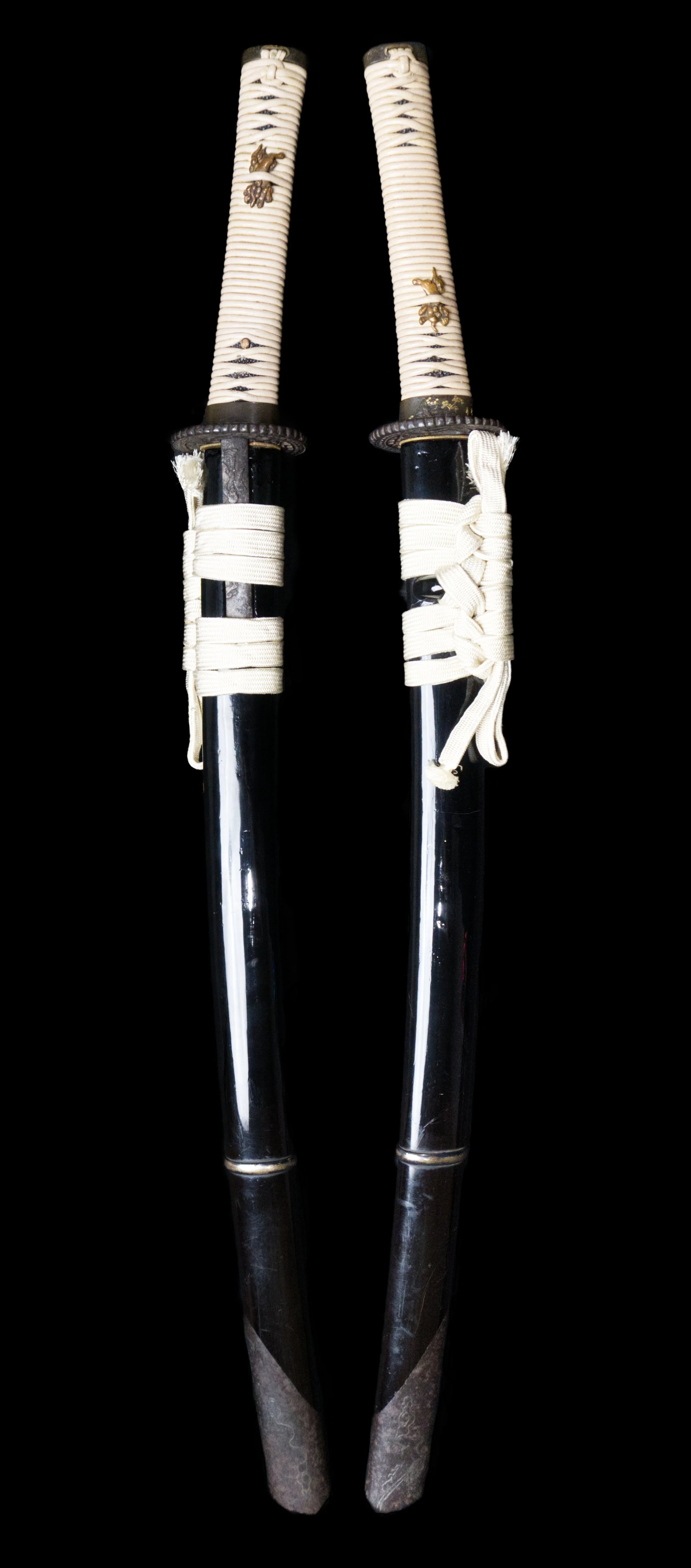
This wakizashi is accompanied by an attractive koshirae, featuring a refined combination of black lacquer, ivory-coloured leather wrapping, and traditional metal fittings.
The saya is finished in a lustrous black lacquer, with a contrasting textured finish towards the lower portion, ending in an iron kojiri. The koshirae also comes complete with a kozuka, adding to the traditional character of the mounting.
The tsuka features an elegant ivory-coloured leather kawa-maki over black samegawa, creating a striking contrast between the pale leather and the dark rayskin beneath. The menuki depict shishi (Japanese guardian lions) in lively, expressive poses, while the dark metal fuchi-kashira provides a complementary finish, with delicate decorative detailing visible on the fuchi.
The circular iron tsuba features an intricate symmetrical sukashi design, with decorative openwork surrounding the central nakago-ana, enclosed within a distinctive scalloped rim. Its aged iron surface exhibits an attractive patina, lending the fitting a classical appearance.