
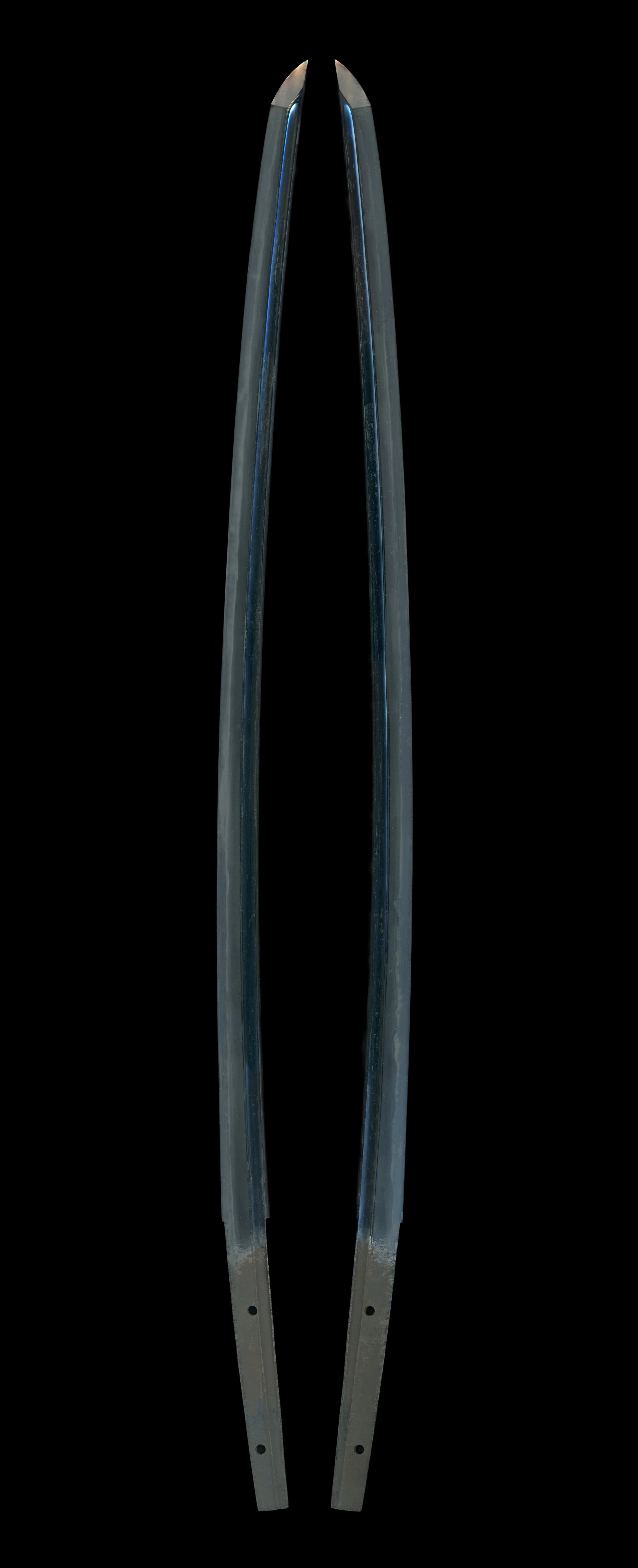
Mumei Taira Takada Katana
無銘(平高田)刀
Item TKC005
Period:Koto - Muromachi
Designation: Hozon
Mei (Signature): Mumei Attributed to Taira Takada
無銘(平高田)Nakago - 17cm
Mekugiana - 2 holes
Nagasa - 67.9cm
Sori - 1.6cm
Motohaba - 2.8cm
Sakihaba - 1.8cm
Kissaki - 3cm
Motokasane: 0.68cm
¥ 370,000
Attribution: Taira Takada (平高田)
Taira Takada refers to swords associated with the early Takada school of Bungo Province in Kyushu. The tradition was founded by Takada Tomoyuki during the Nanbokucho period, following his study of sword forging techniques in Bizen Province. Upon returning to Bungo, he established a local lineage that blended Bizen-influenced workmanship with regional production.
Before the Edo period, swordsmiths working in Takada village were collectively known as Taira Takada, a designation used to distinguish early Takada work from later generations. Many swords attributed to Taira Takada are understood to date to the Muromachi period, when the school was actively producing weapons for widespread use during times of conflict.
During the Sengoku period, Takada swordsmiths supplied blades throughout Kyushu and were held in high regard for their practicality and reliability, with contemporary reputation placing their work alongside that of Mino and Bizen. The school is historically linked to the Otomo clan, rulers of the Bungo domain, whose military expansion created sustained demand for locally forged swords.
The success of the Takada school was supported by Kyushu’s active trade networks and by access to high-quality iron sand and charcoal from the Mount Sobo and Katamuki region. Today, the attribution Taira Takada denotes early Takada production valued for its historical importance, regional character, and role in Kyushu’s martial culture.
This blade has a well-balanced, straightforward shape with a gentle, natural curvature and an overall slim profile. A bo-hi with accompanying soe-hi runs neatly along the blade and continues all the way to the base of the tang, giving the sword a lighter feel and a clean, practical appearance. The kissaki is proportionate and consistent with the rest of the blade.
The polish is in decent condition, allowing the blade’s form and surface to be viewed clearly.
Offered at an accessible price, this sword represents a good, affordable option for collectors looking to acquire a koto-period blade with NBTHK Hozon papers, making it a solid entry point for those seeking an early Japanese sword without a large commitment.